Your Marketing Isn't Broken. You're Measuring the Wrong Things
- Date - 17 Aug 2026 12:16 pm / by Dhruv Upadhyay
It Always Starts With the Same Sentence
Every few weeks, I find myself having a version of the same conversation. The business changes, the industry changes, and the size of the company changes, but the concern is almost always the same.
“Our marketing just isn’t working.”
It’s rarely said with frustration alone. More often, it’s accompanied by confusion. They’ve invested in a new website, started publishing content regularly, improved their online visibility, run paid campaigns, or worked on their SEO performance. On paper, it feels like they’re doing everything they’re supposed to do. Yet the results don’t seem to justify the effort, and slowly, the conclusion becomes inevitable: the marketing must be broken.
For a long time, I accepted that conclusion too. If someone wasn’t getting the outcomes they expected, I assumed the strategy needed to change or the execution had gone wrong. But the more businesses I worked with, the more I realised that the conversation rarely began with customers or the market. It almost always began with a dashboard.
That made me wonder if we sometimes reach the wrong conclusion because we’re asking the wrong questions.
Somewhere Along the Way, the Dashboard Became the Judge
Marketing today is incredibly measurable, and that’s one of its greatest strengths. We can see how many people visited a website, where they came from, which pages they viewed, how long they stayed, and whether they completed an enquiry form. Tools like website analytics have made it possible to understand our audiences in ways that weren’t possible a decade ago.
But I’ve also noticed something else. The easier it became to measure everything, the easier it became to believe that everything important could be measured.
A page loses a few positions in search engine rankings, and suddenly the entire SEO strategy feels questionable. Organic traffic grows more slowly than expected, and confidence starts to fade. A campaign generates fewer website leads than last month, and months of thoughtful work begin to feel like they weren’t worth it.
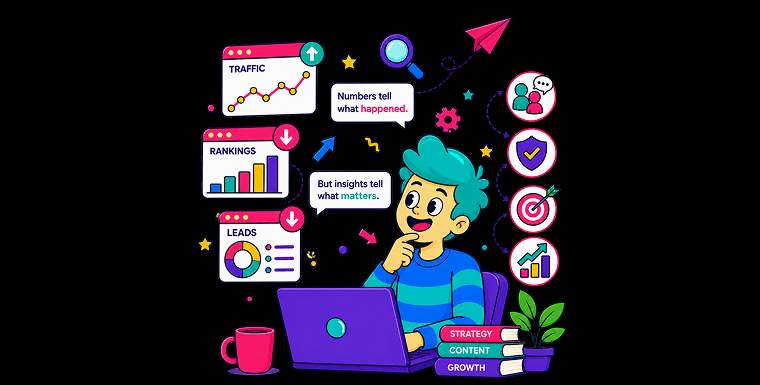
The reports aren’t wrong. They simply tell one part of the story. Somewhere along the way, we’ve started treating them as the final verdict instead of one piece of evidence.
When Good Marketing Looks Like Bad Marketing
One experience changed the way I think about this.
I was looking at two businesses around the same time. The first had almost everything a marketer hopes to see. Their organic traffic was increasing, their search visibility was improving, and their reports suggested that more people were discovering the business every month. If you only looked at the numbers, it appeared to be a success story.
Yet the business owner didn’t feel successful.
“We’re getting more visitors,” they told me, “but it doesn’t feel like we’re growing.”
A few weeks later, I looked at another business. Their reports were far less exciting. Traffic was steady rather than spectacular, and there wasn’t a dramatic increase in impressions or clicks. But conversations with potential customers felt different. People arrived with a clear understanding of what the company offered. They asked thoughtful questions instead of basic ones. Many had spent time reading multiple articles before making contact.
Nothing about their reports stood out.
Everything about their customer conversations did.
Two Stories That Didn't Match the Numbers
Those two businesses stayed with me because they challenged something I had always assumed. We often think digital marketing ROI should reveal itself quickly. If traffic grows, enquiries should grow. If rankings improve, business should improve.
Reality is rarely that neat.
People don’t usually make important decisions after one visit to a website. They compare options, ask colleagues, read reviews, return weeks later, and sometimes disappear completely before coming back at exactly the right moment. A dashboard might record those as separate sessions. A business owner experiences them as one customer gradually building confidence.
That’s when I started seeing marketing reports differently. They measure activity remarkably well, but they don’t always capture the moments that actually influence a decision.
We Celebrate the Numbers That Are Easy to See
I’ve often wondered whether marketers and business owners alike have become attached to the numbers that are easiest to report.
Traffic is easy to explain.
Clicks are easy to compare.
Reach, impressions, and engagement all fit neatly into a presentation.
The harder conversations are about trust, clarity, and confidence. They’re difficult to summarise in a chart, yet they often determine whether someone chooses to do business with you.
I’ve seen businesses celebrate a sharp increase in visitors while quietly wondering why sales conversations hadn’t changed. I’ve also seen businesses with modest traffic build remarkable relationships because every visitor arrived with the right expectations.
The difference wasn’t the number of people visiting the website. It was what those visitors experienced once they arrived.
Looking Busy Isn't the Same as Building Trust
This has gradually changed the way I think about marketing KPIs. I still look at traffic, rankings, and website leads because they provide valuable signals. But I’ve become more interested in the questions that those metrics can’t answer on their own.
Did visitors find what they expected?
Did the message reduce uncertainty or create more of it?
Did the content help someone understand the business, or did it simply attract another click?
Those questions don’t appear in most dashboards, but they often tell me more than the numbers themselves. In my experience, meaningful growth usually follows when a business becomes clearer, more trustworthy, and more relevant to the people it’s trying to reach.
The Work Nobody Sees Behind a Good Campaign
One thing I’ve come to appreciate about marketing is that most of its important work happens long before a campaign goes live. People see the advertisement, the blog, or the landing page, but they rarely see the thinking behind it.
A good campaign often begins with listening rather than creating. It starts with understanding how customers describe their problems, what they’re searching for, why they hesitate, and what gives them confidence to move forward. It involves analysing user behavior, reviewing SEO performance, studying search intent, and refining messages until they feel genuine rather than persuasive.
None of that work is particularly visible. It doesn’t produce a graph or a headline metric, yet it shapes almost every result that follows.
The more time I’ve spent working in digital marketing, the more I’ve realised that successful campaigns are rarely built by chasing better numbers. They’re built by understanding people a little better than we did yesterday.

Written By
I’m a digital marketing strategist who enjoys turning business goals into clear digital strategies. My work spans SEO, audience research, content strategy, and digital growth, but the real focus is always the same: understanding what people are looking for and finding better ways for brands to connect with them. I’m particularly interested in the space where data meets creativity, using insights to shape strategies that are both practical and meaningful. Through my work, I share the ideas, observations, and experiences that continue to shape how I approach marketing.