When Everything Can Be Created, What Is Worth Creating?
- Date - 19 Aug 2026 12:16 pm / by Naved Aejaz
A perspective on creativity, technology, and what makes design valuable
Imagine a mountain.
It is tall, uneven, rough around the edges. Its peak may be sharp, its surface imperfect, and its shape completely unpredictable.
It never asked anyone what it should look like.
Neither did the trees.
Neither did the flowers.
Nature doesn’t take feedback, review references, or come back with three options for approval.
It simply exists.
And somehow, that is part of what makes it beautiful.
Now imagine if nature worked differently.
What if mountains could take requests?
“Can you make this one rounder?”
“Make the trees taller.”
“Can we make the flowers brighter?”
“Remove that awkward rock.”
Eventually, everything around us could look exactly the way we wanted.
Sounds ideal.
But if everything is made according to our expectations, what happens to surprise?
And if nothing surprises us anymore, what makes something special?
When Creation Becomes Easier
Creative technology has changed the creative process dramatically.
Ideas can become images in seconds. Concepts can be explored before they are produced.
Different creative directions can be tested without committing significant time or resources.
For modern creative teams, this means more possibilities than ever before.
AI in design, generative tools, digital prototyping and advanced product visualization have made
experimentation faster and more accessible.
That’s exciting.
But more possibilities create a new challenge.
When almost anything can be created, the difficult question is no longer:
“Can we make it?”
It becomes:
“Is it worth making?”
Consider the Spherical Mountain
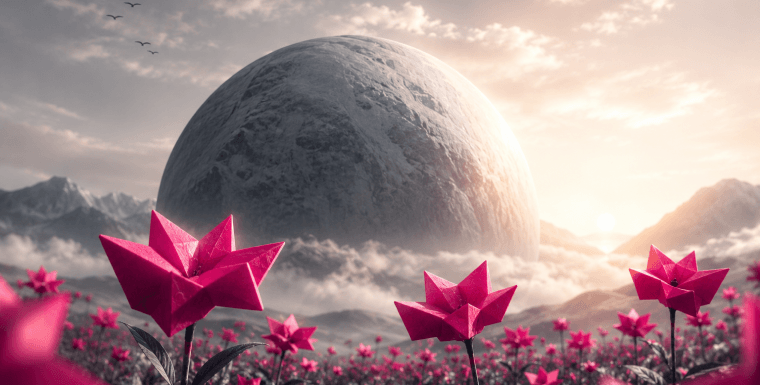
Imagine two perfectly spherical mountains.
They look exactly the same.
One formed naturally over millions of years.
The other was created digitally in seconds.
Which one is more valuable?
There isn’t necessarily one correct answer.
If you need a visual for a website, presentation or brand campaign, the digital mountain might be exactly right.
But standing in front of the real mountain is a different experience.
You know it exists.
You know it wasn’t designed to impress you.
You know its shape is the result of something that happened long before you arrived.
The visual may be identical.
The story isn’t.
And that’s an important distinction.
Because value isn’t always determined by what something looks like.
Sometimes it comes from where it came from, why it exists, and what it makes us feel.
Design Has Always Been More Than Execution
Design is often associated with the final visual.
The layout.
The typography.
The color.
The image.
The animation.
But behind strong brand identity and visual communication is a series of decisions.
What should be communicated?
What should be removed?
What should people notice first?
What should they remember?
What should they feel?
The strongest brand experiences aren’t simply recognizable. They create a consistent point of view that can move naturally across different environments, from a physical product to a digital experience.
Technology can help us explore and produce answers faster.
But the quality of the outcome still depends heavily on the quality of the decisions behind it.
More Options Don't Necessarily Mean Better Ideas
Imagine having five creative options.
Now imagine having five hundred.
The second situation sounds exciting, but it can also create a different problem.
How do you know which one matters?
This is where judgment becomes important.
Not simply knowing what looks good, but understanding:
- What feels relevant
- What feels distinctive
- What fits the audience
- What supports the message
- What people are likely to remember
This is where creative strategy becomes valuable.
The strongest ideas don’t exist simply because they look impressive.
They connect a business objective with a human insight.
When creation becomes easier, choosing well becomes increasingly important.
The Beauty of the Imperfect
Think about a flower.
Its petals aren’t perfectly identical.
One might bend slightly differently. Another might have a small mark. Its shape may not follow any deliberate geometry.
Yet we don’t look at it and think:
“This needs another round of refinement.”
Those differences are part of its character.
In a world where almost anything can be polished, corrected and optimized, perhaps we should remember that perfection isn’t always the goal.
Sometimes, the unexpected detail is what makes something memorable.
And that matters in visual storytelling too.
The most effective story isn’t necessarily the one with the most elaborate film production.
It’s the one that leaves something behind after the screen goes dark.
So Where Does Technology Leave Creativity?
Perhaps it gives creativity more room to breathe.
We can test ideas earlier.
Explore more directions.
Build prototypes faster.
Visualize products before they exist.
Imagine environments that would otherwise be difficult or expensive to produce.
Develop visual worlds before a camera ever starts rolling.
That changes the process.
But efficiency isn’t the same as creativity.
The real opportunity is to use technology to spend more time on the things that matter:
The idea.
The story.
The experience.
The decision.
The Future Isn't About Creating More
We’re going to have more images.
More videos.
More concepts.
More campaigns.
More digital experiences.
More possibilities.
That part is almost inevitable.
The interesting question is whether those things will have something meaningful to say.
Because when beautiful images become easier to create, beauty alone becomes less distinctive.
A memorable campaign needs more than aesthetics.
A meaningful brand experience needs more than functionality.
A compelling film needs more than beautiful frames.
Each needs a reason to exist.
Perhaps That's What the Mountain Teaches Us
The naturally formed spherical mountain and the digitally created one can look exactly the same.
Neither has to be better.
They simply represent different kinds of creation.
One reminds us of what can exist without our intervention.
The other demonstrates what we can imagine and bring to life.
And perhaps the opportunity is not to choose between them.
It is to understand the value of both.
Because as technology makes creation easier, the role of creativity may become less about making something possible,
and more about deciding what is worth making possible.
The Tools Will Change. The Thinking Still Matters.
The creative landscape will continue to expand.
New tools will appear. New methods will emerge. The boundaries between design, technology, storytelling and digital experiences will become increasingly fluid.
But the foundation remains surprisingly simple:
Understand the problem.
Understand the people.
Find the idea.
Make it matter.
The tools will keep changing.
The possibilities will keep expanding.
But meaningful ideas will still need a reason to exist.
And that’s where the future of creative strategy and brand experience becomes most interesting, not in creating everything we possibly can, but in creating the things that are genuinely worth people’s attention.
Perhaps the future of creativity isn’t about creating a perfect mountain. It’s about knowing which mountain is worth climbing.

Written By
I’m a multidisciplinary designer with experience across UI/UX design, motion graphics,3D animation, and multimedia production.
My work focuses on blending product design, visual storytelling, and generative AI tools to create engaging digital experiences and compelling visual content.
Over the years I’ve worked with animation studios, creative agencies, ed-tech platforms, and Gaming Industry, which has helped me develop a strong understanding of both creative design and product development workflows.