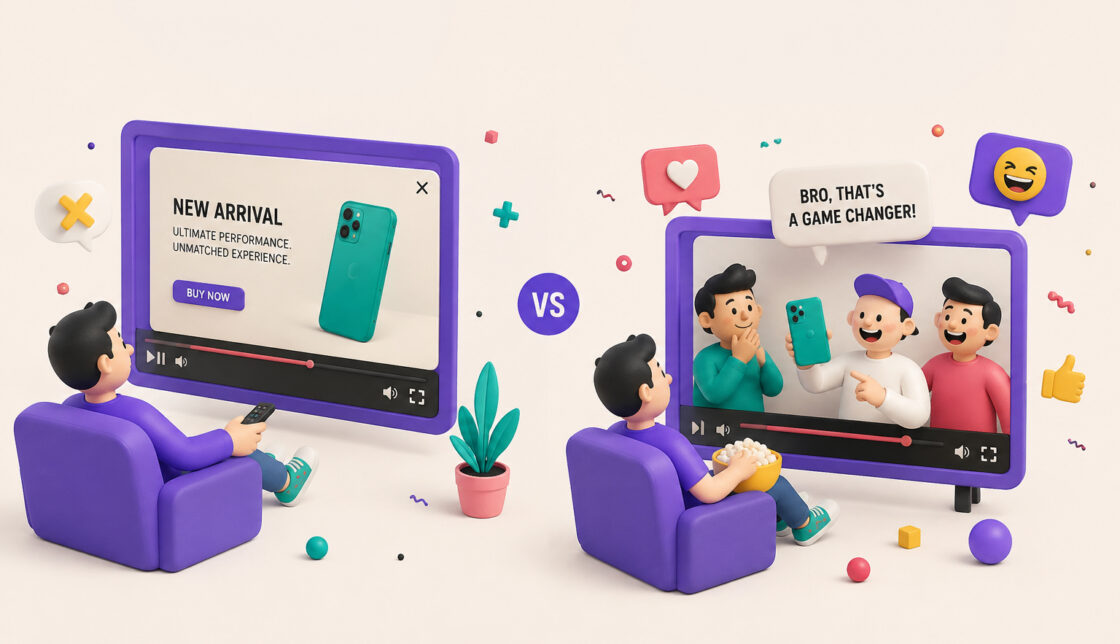
Your expertise is fluent. Your brand is still mumbling in the corner.

- Date - 29 Sep 2026 02:11 pm / by Suraj Kumar
Why smart firms sound the same, and what leaders can do about it.
Most leaders in expertise businesses know their firm is better than its brand suggests. The work is harder than the website admits. The clients are bigger than the case studies can say. And the gap between what the firm knows and what the market hears keeps getting wider.
That gap is rarely a talent problem. It is a legibility problem.
The firm can solve a problem most buyers cannot even describe. Then it walks into the market and describes itself like a brochure that lost a bet.
Every category has a uniform. And a script.
Study any category long enough and you will find its uniform. In cybersecurity it is locks, shields, fingerprints and blue gradients. Everyone is dressed to look secure. So nobody looks like anyone in particular.
The script is worse. Trusted partner. Innovative solutions. Customer centric. End to end. World class. Read five homepages in a row and they start to feel like one firm with four cousins.
The uniform feels safe because it signals membership. That is exactly why it fails. When everyone says the same thing, the buyer stops listening to what is said and starts looking at price. Or at whoever already knows someone at the company. Neither of those is a brand strategy. One is a discount. The other is a golf membership.
The About Us page is where brands go to hide
Ask a leadership team what makes the firm different and you will get a sharp, specific, slightly heated answer. Then look at the About Us page. The heat is gone. Someone has sanded it down into a mission statement that could run for a bank, a bakery or a mid sized logistics company.
This happens for a sensible reason. Specific claims feel risky. Generic claims feel safe. But in brand communications, safe is just a quieter word for invisible.
A useful rule. If a competitor could publish your sentence without changing a word, it is not your sentence. It is the category’s. You are renting it.
Consistency is not boring. Inconsistency is expensive.
Here is how most brands drift. The website says one thing. The sales deck says another. The founder’s LinkedIn says a third, with better jokes. The event booth says nothing at all, just a logo and a bowl of mints.
Each piece was made by a capable person with a deadline. None of them was made from the same idea. So the buyer meets four firms that share a name.
A strong brand is one idea doing different jobs across every surface. The homepage introduces it. The case study proves it. The deck teaches it. The social post repeats it in a shorter sentence. Repetition feels tedious from the inside. From the outside, it is the only way anyone remembers you.
Why this is a leadership call, not a marketing ticket
It is tempting to file brand communications under marketing and move on. It will not survive there alone. Three things need cover from the top.
First, someone has to say no to the category script. That means signing off on language that sounds unfamiliar in a room full of trusted partners.
Second, someone has to name the awkward truth out loud. Teams avoid it because it feels like weakness. Leaders are the only ones with permission to call it a strength.
Third, someone has to protect the idea once it exists. Brands rarely die in one bad campaign. They die in a hundred small exceptions, each approved because it was only this once.
A test worth running this week
Take the logo off your homepage, your latest deck and your last social post. Show them to a client. Ask if they could still tell it was you.
If the answer is no, your brand is borrowing credibility from the category. If the answer is yes, it is earning its own.
If the answer is “who are you again”, that is also useful data. Painful, but useful.

Written By
I work in marketing and client success, where my days revolve around understanding businesses, people, ideas, and what makes them connect. It has also made me endlessly curious about why people think, buy, create, and communicate the way they do.
Outside work, I m just as curious about pretty much everything else. I like questioning the obvious, connecting random dots, and finding interesting ideas in ordinary conversations and experiences.
I m someone who enjoys learning, observing, experimenting, and occasionally overthinking things that probably didn t need that much thought. I guess that curiosity is what keeps things interesting.