Generative Design Experiments

Generative Design Experiments
Where volume meets verdict. The lab generates creative work at scale not to ship it, but to judge it and in doing so produces the rarest material in machine intelligence: taste, written down.
An opinion, repeated consistently, becomes a signal.
Every learning system improves the same way. It attempts. It is judged. It adjusts. For mathematics and code, the judging can be written as a rule the proof is valid or it is not. For a mark, a layout, a line of copy, there is no rule. There is only a trained eye. Generative Design Experiments exists to put that eye to work at a scale machines can learn from.
The stream generates paired creative outputs by the hundred: two marks for the same brand, two layouts for the same grid, two taglines for the same promise. Each pair is placed before a senior designer, and the verdict is recorded which is better, why, and in the language of craft rather than the language of personal preference. One judgment is an opinion. Thousands of them, rendered consistently and with reasoning attached, are preference data: the raw material from which a learning system acquires the ability to prefer the better idea.
Inside the studio, this is a discipline of exploration a way of testing instinct against volume. Outside it, the same practice produces exactly what training pipelines for creative intelligence cannot manufacture for themselves: a reward signal for the unverifiable.
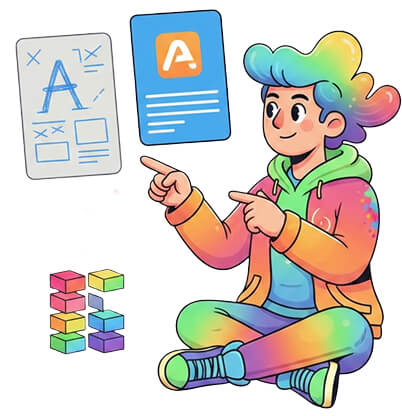
Generate, pair, judge, record. Then do it again.
Generation sprints produce variant families designed for comparison. Pairs are assembled to isolate a single variable the weight of a mark, the temperature of a palette, the register of a line so that each verdict carries clean, attributable signal rather than a blur of differences.
Review is blind. The judge does not know which output came from which source or which iteration, only the brief and the pair. Verdicts are written in a structured form: the preference, the confidence, the reasoning, and the failure mode named precisely a generic superlative substituting for an idea, ornament compensating for absent structure, fluency mistaken for meaning. Judges calibrate against one another in standing sessions, so that even disagreement becomes data rather than noise.
What accumulates is a body of domain-organised preference sets identity, packaging, layout, voice each verdict carrying the rationale that turns a label into a lesson. The reasoning is the product. A score teaches a machine what was preferred; a written rationale teaches it what to look for next time.


Better, according to whom?
Preference is not universal, and the systems now learning to create have been taught otherwise. Trained on archives that overwhelmingly favour one part of the world, they inherit one tradition’s conventions its framing, its lighting, its proportions, its restraint and treat them as neutral. A verdict panel drawn from a single city would do the same thing: teach a machine that city’s taste and call it the world’s.
Enki judges from three rooms on three continents Gurgaon, Paris, Boston. What reads as premium in Paris, where restraint and white space carry authority, can read as cold in Gurgaon, where festival colour holds an emotional charge that minimalism cannot reach. What lands as refreshingly direct in Boston can sound blunt elsewhere. The lab records not only the verdict but its vantage: the same pair judged across markets, with divergence preserved rather than averaged away.
This is the difference between a reward signal and a flattening. A machine taught by one culture’s preferences homogenises everything it touches. A machine taught by plural, situated judgment learns something far more valuable: that better has a context and that the first question of good design is which world it is being made for.
Generative Design Experiments, already at work.
A standing generate-and-judge practice: paired outputs, blind review by working creative directors across three studios, every verdict captured with its rationale, its confidence, and its market context.
Exploration for the studio. Preference signal for anyone teaching a machine to prefer the better idea.